
Hey,
So I see you liked the last OEM Report post. But some have asked me for a table with all database space usage something like a summary table for executive view, once the last report gives it by the database, right…
Here it goes:
– I hid the target names for safety, but check on the last column “AVG 6-m Growth”. This is the one you want.
– This obviously needs to be in another Report, once no DB filter is present. So, here is an example of the table and the code:

And let me ask you: Would you like to have this view from the ASM Perspective? Like this?
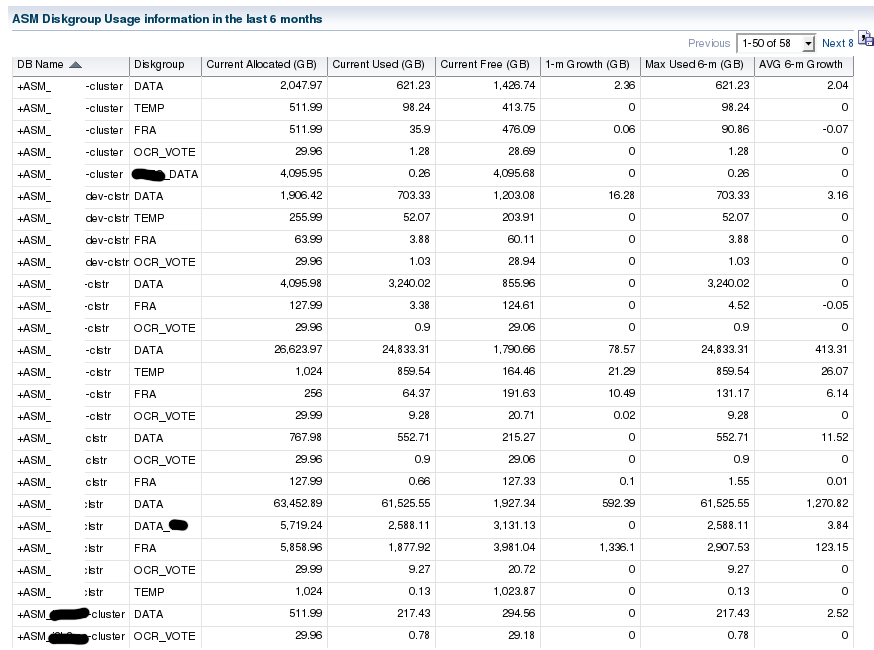
Great, right?
The codes for this:
NOTE: We got comments on this regarding the sysdate implicit conversion to timestamp. It worked fine to by, but in case you have any issue, you might want to check over this. Thank you for pointing out, Günter Nowak!
#Database Space Usage information in the last 6 months
select CURRENT_ALLOCATEDSPACE.TARGET_NAME,
round(CURRENT_ALLOCATEDSPACE.SIZE_GB,2) as "Current allocated(GB)",
round(CURRENT_USEDSIZE.SIZE_GB,2) as "Current Used (GB)",
round(CURRENT_ALLOCATEDSPACE.SIZE_GB- CURRENT_USEDSIZE.SIZE_GB,2) as "Current Free (GB)",
round(CURRENT_USEDSIZE.SIZE_GB-USED_LAST_MONTH.SIZE_GB,2) as "1-m Growth (GB)",
round(MAX_USED.SIZE_GB,2) as "Max Used 6-m (GB)",
round((CURRENT_USEDSIZE.SIZE_GB- FIRST_USEDSPACE.SIZE_GB)/6,2) as "AVG 6-m Growth "
from
		(select T.TARGET_NAME,  --FIRST USED SPACE
		M.ROLLUP_TIMESTAMP as MONTH_TIMESTAMP,
		sum(M.AVERAGE/1024)as SIZE_GB
		from   MGMT$METRIC_DAILY M,
		MGMT$TARGET_TYPE T,
			(select T.TARGET_NAME, MIN(ROLLUP_TIMESTAMP) MIN_TIME
			from  MGMT$METRIC_DAILY M, MGMT$TARGET_TYPE T
			where (T.TARGET_TYPE='rac_database' OR
			(T.TARGET_TYPE='oracle_database' and T.TYPE_QUALIFIER3 != 'RACINST')) and
			M.TARGET_GUID=T.TARGET_GUID and
			M.METRIC_GUID=T.METRIC_GUID and
			T.METRIC_NAME='tbspAllocation' and
			T.METRIC_COLUMN='spaceUsed' and
			M.METRIC_NAME=T.METRIC_NAME and
			M.METRIC_COLUMN=T.METRIC_COLUMN and
			M.ROLLUP_TIMESTAMP >= to_timestamp(trunc((sysdate-180),'MM')) and
			M.ROLLUP_TIMESTAMP <= to_timestamp(sysdate) 			group by T.TARGET_NAME, 			M.METRIC_COLUMN) MIN_DATE 		where (T.TARGET_TYPE='rac_database' OR  		(T.TARGET_TYPE='oracle_database' and T.TYPE_QUALIFIER3 != 'RACINST')) and       		M.TARGET_GUID=T.TARGET_GUID and 		M.METRIC_GUID=T.METRIC_GUID and 		T.METRIC_NAME='tbspAllocation' and 		T.METRIC_COLUMN='spaceUsed' and 		M.METRIC_NAME=T.METRIC_NAME and 		M.METRIC_COLUMN=T.METRIC_COLUMN and 		T.TARGET_NAME=MIN_DATE.TARGET_NAME AND M.ROLLUP_TIMESTAMP=MIN_DATE.MIN_TIME 		group by t.target_name,m.rollup_timestamp) FIRST_USEDSPACE,	--FIRST USED SPACE 		(select T.TARGET_NAME,    --CURRENT ALLOCATED SPACE 		M.ROLLUP_TIMESTAMP as MONTH_TIMESTAMP, 		sum(M.AVERAGE/1024)as SIZE_GB 		from   MGMT$METRIC_DAILY M, 		MGMT$TARGET_TYPE T, 			(select T.TARGET_NAME, max(ROLLUP_TIMESTAMP) MAX_TIME  			from  MGMT$METRIC_DAILY M, MGMT$TARGET_TYPE T	   			where (T.TARGET_TYPE='rac_database' OR  			(T.TARGET_TYPE='oracle_database' and T.TYPE_QUALIFIER3 != 'RACINST')) and       			M.TARGET_GUID=T.TARGET_GUID and 			M.METRIC_GUID=T.METRIC_GUID and 			T.METRIC_NAME='tbspAllocation' and 			T.METRIC_COLUMN='spaceAllocated' and 			M.METRIC_NAME=T.METRIC_NAME and 			M.METRIC_COLUMN=T.METRIC_COLUMN and 			M.ROLLUP_TIMESTAMP >= to_timestamp(trunc((sysdate-180),'MM')) and
			M.ROLLUP_TIMESTAMP <= to_timestamp(sysdate) 			group by T.TARGET_NAME, 			M.METRIC_COLUMN) MAX_DATE 		where (T.TARGET_TYPE='rac_database' OR  		(T.TARGET_TYPE='oracle_database' and T.TYPE_QUALIFIER3 != 'RACINST')) and       		M.TARGET_GUID=T.TARGET_GUID and 		M.METRIC_GUID=T.METRIC_GUID and 		T.METRIC_NAME='tbspAllocation' and 		T.METRIC_COLUMN='spaceAllocated' and 		M.METRIC_NAME=T.METRIC_NAME and 		M.METRIC_COLUMN=T.METRIC_COLUMN and 		T.TARGET_NAME=MAX_DATE.TARGET_NAME AND M.ROLLUP_TIMESTAMP=MAX_DATE.MAX_TIME 		group by t.target_name,m.rollup_timestamp) CURRENT_ALLOCATEDSPACE,--CURRENT ALLOCATED SPACE 		(select T.TARGET_NAME,  --USED SPACE IN LAST MONTH 		M.ROLLUP_TIMESTAMP as MONTH_TIMESTAMP, 		sum(M.AVERAGE/1024)as SIZE_GB 		from   MGMT$METRIC_DAILY M, 		MGMT$TARGET_TYPE T, 			(select T.TARGET_NAME, MIN(ROLLUP_TIMESTAMP) MIN_TIME  			from  MGMT$METRIC_DAILY M, MGMT$TARGET_TYPE T	   			where (T.TARGET_TYPE='rac_database' OR  			(T.TARGET_TYPE='oracle_database' and T.TYPE_QUALIFIER3 != 'RACINST')) and       			M.TARGET_GUID=T.TARGET_GUID and 			M.METRIC_GUID=T.METRIC_GUID and 			T.METRIC_NAME='tbspAllocation' and 			T.METRIC_COLUMN='spaceUsed' and 			M.METRIC_NAME=T.METRIC_NAME and 			M.METRIC_COLUMN=T.METRIC_COLUMN and 			M.ROLLUP_TIMESTAMP >= to_timestamp(trunc((sysdate-30),'MM')) and
			M.ROLLUP_TIMESTAMP <= to_timestamp(sysdate) 			group by T.TARGET_NAME, 			M.METRIC_COLUMN) MIN_DATE 		where (T.TARGET_TYPE='rac_database' OR  		(T.TARGET_TYPE='oracle_database' and T.TYPE_QUALIFIER3 != 'RACINST')) and       		M.TARGET_GUID=T.TARGET_GUID and 		M.METRIC_GUID=T.METRIC_GUID and 		T.METRIC_NAME='tbspAllocation' and 		T.METRIC_COLUMN='spaceUsed' and 		M.METRIC_NAME=T.METRIC_NAME and 		M.METRIC_COLUMN=T.METRIC_COLUMN and 		T.TARGET_NAME=MIN_DATE.TARGET_NAME AND M.ROLLUP_TIMESTAMP=MIN_DATE.MIN_TIME 		group by t.target_name,m.rollup_timestamp) USED_LAST_MONTH, --USED SPACE IN LAST MONTH 		(select A_SIZE.TARGET_NAME, --MAX USED SPACE IN 6 MONTHS 		round(max(A_SIZE.SIZE_GB),2) as SIZE_GB 		from (select T.TARGET_NAME,   			M.ROLLUP_TIMESTAMP as MONTH_TIMESTAMP, 			sum(M.AVERAGE/1024) as SIZE_GB 			from MGMT$METRIC_DAILY M, 			MGMT$TARGET_TYPE T 			where (T.TARGET_TYPE='rac_database' OR  			(T.TARGET_TYPE='oracle_database' and T.TYPE_QUALIFIER3 != 'RACINST')) and       			M.TARGET_GUID=T.TARGET_GUID and 			M.METRIC_GUID=T.METRIC_GUID and 			T.METRIC_NAME='tbspAllocation' and 			T.METRIC_COLUMN='spaceUsed' and 			M.ROLLUP_TIMESTAMP >= to_timestamp(trunc((sysdate-180),'MM')) and
			M.ROLLUP_TIMESTAMP <= to_timestamp(sysdate) 			group by T.TARGET_NAME, 			M.METRIC_COLUMN, 			M.ROLLUP_TIMESTAMP) A_SIZE 		group by A_SIZE.TARGET_NAME) MAX_USED,	--MAX USED SPACE IN 6 MONTHS
			(select T.TARGET_NAME,   --CURRENT USED SPACE
				M.ROLLUP_TIMESTAMP as MONTH_TIMESTAMP, 		sum(M.AVERAGE/1024)as SIZE_GB 		from   MGMT$METRIC_DAILY M, 		MGMT$TARGET_TYPE T, 			(select T.TARGET_NAME, max(ROLLUP_TIMESTAMP) MAX_TIME  			from  MGMT$METRIC_DAILY M, MGMT$TARGET_TYPE T	   			where (T.TARGET_TYPE='rac_database' OR  			(T.TARGET_TYPE='oracle_database' and T.TYPE_QUALIFIER3 != 'RACINST')) and      	 			M.TARGET_GUID=T.TARGET_GUID and 			M.METRIC_GUID=T.METRIC_GUID and 			T.METRIC_NAME='tbspAllocation' and 			T.METRIC_COLUMN='spaceUsed' and 			M.METRIC_NAME=T.METRIC_NAME and 			M.METRIC_COLUMN=T.METRIC_COLUMN and M.ROLLUP_TIMESTAMP >= to_timestamp(trunc((sysdate-180),'MM')) and
			M.ROLLUP_TIMESTAMP <= to_timestamp(sysdate)
			group by T.TARGET_NAME,
			M.METRIC_COLUMN) MAX_DATE
		where (T.TARGET_TYPE='rac_database' OR
		(T.TARGET_TYPE='oracle_database' and T.TYPE_QUALIFIER3 != 'RACINST')) and
		M.TARGET_GUID=T.TARGET_GUID and
		M.METRIC_GUID=T.METRIC_GUID and
		T.METRIC_NAME='tbspAllocation' and
		T.METRIC_COLUMN='spaceUsed' and
		M.METRIC_NAME=T.METRIC_NAME and
		M.METRIC_COLUMN=T.METRIC_COLUMN and
		T.TARGET_NAME=MAX_DATE.TARGET_NAME AND M.ROLLUP_TIMESTAMP=MAX_DATE.MAX_TIME
		group by t.target_name,m.rollup_timestamp) CURRENT_USEDSIZE
WHERE
CURRENT_ALLOCATEDSPACE.TARGET_NAME=CURRENT_USEDSIZE.TARGET_NAME and
CURRENT_ALLOCATEDSPACE.TARGET_NAME=USED_LAST_MONTH.TARGET_NAME and
CURRENT_ALLOCATEDSPACE.TARGET_NAME=FIRST_USEDSPACE.TARGET_NAME and
CURRENT_ALLOCATEDSPACE.TARGET_NAME=MAX_USED.TARGET_NAME
order by 3 desc
# ASM Diskgroup Usage information in the last 6 months
select CURRENT_ALLOCATEDSPACE.TARGET_NAME "DB Name" ,
CURRENT_ALLOCATEDSPACE.KEY_VALUE  "Diskgroup",
round(CURRENT_ALLOCATEDSPACE.SIZE_GB,2) as "Current Allocated (GB)",
round(CURRENT_ALLOCATEDSPACE.SIZE_GB-CURRENT_FREESIZE.SIZE_GB,2) as "Current Used (GB)",
round(CURRENT_FREESIZE.SIZE_GB,2) as "Current Free (GB)",
round((CURRENT_ALLOCATEDSPACE.SIZE_GB-CURRENT_FREESIZE.SIZE_GB)-(TOTAL_SPACE_LAST_MONTH.SIZE_GB-FREE_LAST_MONTH.SIZE_GB),2) as "1-m Growth (GB)",
round(USED_SPACE_INFORMATION.USED_SPACE,2) as "Max Used 6-m (GB)",
round(((CURRENT_ALLOCATEDSPACE.SIZE_GB-CURRENT_FREESIZE.SIZE_GB)- (FIRST_TOTAL_SPACE.SIZE_GB-FIRST_FREESPACE.SIZE_GB))/6,2) as "AVG 6-m Growth"
from
		(select T.TARGET_NAME,  --FIRST FREE SPACE
		M.KEY_VALUE,
		M.ROLLUP_TIMESTAMP as MONTH_TIMESTAMP,
		sum(M.AVERAGE/1024)as SIZE_GB
		from   MGMT$METRIC_DAILY M,
		MGMT$TARGET_TYPE T,
			(select T.TARGET_NAME, M.KEY_VALUE, MIN(ROLLUP_TIMESTAMP) MIN_TIME
			from  MGMT$METRIC_DAILY M, MGMT$TARGET_TYPE T
			where T.TARGET_TYPE='osm_cluster' and
			M.TARGET_GUID=T.TARGET_GUID and
			M.METRIC_GUID=T.METRIC_GUID and
			T.METRIC_NAME='DiskGroup_Usage' and
			T.METRIC_COLUMN='free_mb' and
			M.METRIC_NAME=T.METRIC_NAME and
			M.METRIC_COLUMN=T.METRIC_COLUMN and
			M.ROLLUP_TIMESTAMP >= to_timestamp(trunc((sysdate-180),'MM')) and
			M.ROLLUP_TIMESTAMP <= to_timestamp(sysdate) 			group by T.TARGET_NAME,M.key_value,M.METRIC_COLUMN) MIN_DATE 		where T.TARGET_TYPE='osm_cluster'  and       		M.TARGET_GUID=T.TARGET_GUID and 		M.METRIC_GUID=T.METRIC_GUID and 		T.METRIC_NAME='DiskGroup_Usage' and 		T.METRIC_COLUMN='free_mb' and 		M.METRIC_NAME=T.METRIC_NAME and 		M.METRIC_COLUMN=T.METRIC_COLUMN and 		T.TARGET_NAME=MIN_DATE.TARGET_NAME AND M.KEY_VALUE=MIN_DATE.KEY_VALUE AND M.ROLLUP_TIMESTAMP=MIN_DATE.MIN_TIME 		group by t.target_name,M.KEY_VALUE, m.rollup_timestamp) FIRST_FREESPACE,	--FIRST FREE SPACE 		(select T.TARGET_NAME,  --FIRST TOTAL  SPACE 		M.KEY_VALUE, 		M.ROLLUP_TIMESTAMP as MONTH_TIMESTAMP, 		sum(M.AVERAGE/1024)as SIZE_GB 		from   MGMT$METRIC_DAILY M, 		MGMT$TARGET_TYPE T, 			(select T.TARGET_NAME, M.KEY_VALUE, MIN(ROLLUP_TIMESTAMP) MIN_TIME  			from  MGMT$METRIC_DAILY M, MGMT$TARGET_TYPE T	   			where T.TARGET_TYPE='osm_cluster' and       			M.TARGET_GUID=T.TARGET_GUID and 			M.METRIC_GUID=T.METRIC_GUID and 			T.METRIC_NAME='DiskGroup_Usage' and 			T.METRIC_COLUMN='total_mb' and 			M.METRIC_NAME=T.METRIC_NAME and 			M.METRIC_COLUMN=T.METRIC_COLUMN and 			M.ROLLUP_TIMESTAMP >= to_timestamp(trunc((sysdate-180),'MM')) and
			M.ROLLUP_TIMESTAMP <= to_timestamp(sysdate) 			group by T.TARGET_NAME,M.key_value,M.METRIC_COLUMN) MIN_DATE 		where T.TARGET_TYPE='osm_cluster'  and       		M.TARGET_GUID=T.TARGET_GUID and 		M.METRIC_GUID=T.METRIC_GUID and 		T.METRIC_NAME='DiskGroup_Usage' and 		T.METRIC_COLUMN='total_mb' and 		M.METRIC_NAME=T.METRIC_NAME and 		M.METRIC_COLUMN=T.METRIC_COLUMN and 		T.TARGET_NAME=MIN_DATE.TARGET_NAME AND M.KEY_VALUE=MIN_DATE.KEY_VALUE AND M.ROLLUP_TIMESTAMP=MIN_DATE.MIN_TIME 		group by t.target_name,M.KEY_VALUE, m.rollup_timestamp) FIRST_TOTAL_SPACE,	--FIRST TOTAL  SPACE		 		(select T.TARGET_NAME,    --CURRENT TOTAL SPACE 		M.KEY_VALUE, 		M.ROLLUP_TIMESTAMP as MONTH_TIMESTAMP, 		sum(M.AVERAGE/1024)as SIZE_GB 		from   MGMT$METRIC_DAILY M, 		MGMT$TARGET_TYPE T, 			(select T.TARGET_NAME, M.KEY_VALUE, max(ROLLUP_TIMESTAMP) MAX_TIME  			from  MGMT$METRIC_DAILY M, MGMT$TARGET_TYPE T	   			where T.TARGET_TYPE='osm_cluster'  and       			M.TARGET_GUID=T.TARGET_GUID and 			M.METRIC_GUID=T.METRIC_GUID and 			T.METRIC_NAME='DiskGroup_Usage' and 			T.METRIC_COLUMN='total_mb' and 			M.METRIC_NAME=T.METRIC_NAME and 			M.METRIC_COLUMN=T.METRIC_COLUMN and 			M.ROLLUP_TIMESTAMP >= to_timestamp(trunc((sysdate-180),'MM')) and
			M.ROLLUP_TIMESTAMP <= to_timestamp(sysdate) 			group by T.TARGET_NAME, m.key_value, 			M.METRIC_COLUMN) MAX_DATE 		where T.TARGET_TYPE='osm_cluster' and       		M.TARGET_GUID=T.TARGET_GUID and 		M.METRIC_GUID=T.METRIC_GUID and 		T.METRIC_NAME='DiskGroup_Usage' and 		T.METRIC_COLUMN='total_mb' and 		M.METRIC_NAME=T.METRIC_NAME and 		M.METRIC_COLUMN=T.METRIC_COLUMN and 		T.TARGET_NAME=MAX_DATE.TARGET_NAME AND M.KEY_VALUE=MAX_DATE.KEY_VALUE AND M.ROLLUP_TIMESTAMP=MAX_DATE.MAX_TIME 		group by t.target_name,m.key_value,m.rollup_timestamp order by 1,3) CURRENT_ALLOCATEDSPACE,--CURRENT TOTAL SPACE 		(select T.TARGET_NAME,  --FREE SPACE IN LAST MONTH 		M.KEY_VALUE, 		M.ROLLUP_TIMESTAMP as MONTH_TIMESTAMP, 		sum(M.AVERAGE/1024)as SIZE_GB 		from   MGMT$METRIC_DAILY M, 		MGMT$TARGET_TYPE T, 			(select T.TARGET_NAME,M.KEY_VALUE, MIN(ROLLUP_TIMESTAMP) MIN_TIME  			from  MGMT$METRIC_DAILY M, MGMT$TARGET_TYPE T	   			where T.TARGET_TYPE='osm_cluster' and       			M.TARGET_GUID=T.TARGET_GUID and 			M.METRIC_GUID=T.METRIC_GUID and 			T.METRIC_NAME='DiskGroup_Usage' and 			T.METRIC_COLUMN='free_mb' and 			M.METRIC_NAME=T.METRIC_NAME and 			M.METRIC_COLUMN=T.METRIC_COLUMN and 			M.ROLLUP_TIMESTAMP >= to_timestamp(trunc((sysdate-30),'MM')) and
			M.ROLLUP_TIMESTAMP <= to_timestamp(sysdate) 			group by T.TARGET_NAME,M.KEY_VALUE) MIN_DATE 		where T.TARGET_TYPE='osm_cluster' and       		M.TARGET_GUID=T.TARGET_GUID and 		M.METRIC_GUID=T.METRIC_GUID and 		T.METRIC_NAME='DiskGroup_Usage' and 		T.METRIC_COLUMN='free_mb' and 		M.METRIC_NAME=T.METRIC_NAME and 		M.METRIC_COLUMN=T.METRIC_COLUMN and 		T.TARGET_NAME=MIN_DATE.TARGET_NAME AND  M.KEY_VALUE=MIN_DATE.KEY_VALUE and  M.ROLLUP_TIMESTAMP=MIN_DATE.MIN_TIME 		group by t.target_name,m.key_value, m.rollup_timestamp) FREE_LAST_MONTH, --FREE SPACE IN LAST MONTH 		(select T.TARGET_NAME,  --TOTAL SPACE IN LAST MONTH		 		M.KEY_VALUE, 		M.ROLLUP_TIMESTAMP as MONTH_TIMESTAMP, 		sum(M.AVERAGE/1024)as SIZE_GB 		from   MGMT$METRIC_DAILY M, 		MGMT$TARGET_TYPE T, 			(select T.TARGET_NAME,M.KEY_VALUE, MIN(ROLLUP_TIMESTAMP) MIN_TIME  			from  MGMT$METRIC_DAILY M, MGMT$TARGET_TYPE T	   			where T.TARGET_TYPE='osm_cluster' and       			M.TARGET_GUID=T.TARGET_GUID and 			M.METRIC_GUID=T.METRIC_GUID and 			T.METRIC_NAME='DiskGroup_Usage' and 			T.METRIC_COLUMN='total_mb' and 			M.METRIC_NAME=T.METRIC_NAME and 			M.METRIC_COLUMN=T.METRIC_COLUMN and 			M.ROLLUP_TIMESTAMP >= to_timestamp(trunc((sysdate-30),'MM')) and
			M.ROLLUP_TIMESTAMP <= to_timestamp(sysdate) 			group by T.TARGET_NAME,M.KEY_VALUE) MIN_DATE 		where T.TARGET_TYPE='osm_cluster' and       		M.TARGET_GUID=T.TARGET_GUID and 		M.METRIC_GUID=T.METRIC_GUID and 		T.METRIC_NAME='DiskGroup_Usage' and 		T.METRIC_COLUMN='total_mb' and 		M.METRIC_NAME=T.METRIC_NAME and 		M.METRIC_COLUMN=T.METRIC_COLUMN and 		T.TARGET_NAME=MIN_DATE.TARGET_NAME AND  M.KEY_VALUE=MIN_DATE.KEY_VALUE and  M.ROLLUP_TIMESTAMP=MIN_DATE.MIN_TIME 		group by t.target_name,m.key_value, m.rollup_timestamp) TOTAL_SPACE_LAST_MONTH, --TOTAL SPACE IN LAST MONTH	 		(SELECT SPACE_ALLOCATED.TARGET_NAME, -- USED_SPACE_INFORMATION 		SPACE_ALLOCATED.KEY_VALUE,  		max(SPACE_ALLOCATED.SIZE_GB- FREE_SPACE.SIZE_GB) USED_SPACE 		FROM( 				select T.TARGET_NAME,  				M.KEY_VALUE,  				M.ROLLUP_TIMESTAMP as MONTH_TIMESTAMP, 				sum(M.AVERAGE/1024) as SIZE_GB 				from MGMT$METRIC_DAILY M, 				MGMT$TARGET_TYPE T 				where T.TARGET_TYPE='osm_cluster' and       				M.TARGET_GUID=T.TARGET_GUID and 				M.METRIC_GUID=T.METRIC_GUID and 				T.METRIC_NAME='DiskGroup_Usage' and 				T.METRIC_COLUMN='total_mb' and 				M.ROLLUP_TIMESTAMP >= to_timestamp(trunc((sysdate-180),'MM')) and
				M.ROLLUP_TIMESTAMP <= to_timestamp(sysdate) 				group by T.TARGET_NAME,	M.KEY_VALUE, 				M.ROLLUP_TIMESTAMP) SPACE_ALLOCATED, 				(select T.TARGET_NAME,  				M.KEY_VALUE,  				M.ROLLUP_TIMESTAMP as MONTH_TIMESTAMP, 				sum(M.AVERAGE/1024) as SIZE_GB 				from MGMT$METRIC_DAILY M, 				MGMT$TARGET_TYPE T 				where T.TARGET_TYPE='osm_cluster' and       				M.TARGET_GUID=T.TARGET_GUID and 				M.METRIC_GUID=T.METRIC_GUID and 				T.METRIC_NAME='DiskGroup_Usage' and 				T.METRIC_COLUMN='free_mb' and 				M.ROLLUP_TIMESTAMP >= to_timestamp(trunc((sysdate-180),'MM')) and
				M.ROLLUP_TIMESTAMP <= to_timestamp(sysdate) 				group by T.TARGET_NAME,	M.KEY_VALUE, 				M.ROLLUP_TIMESTAMP) FREE_SPACE 		WHERE SPACE_ALLOCATED.TARGET_NAME=FREE_SPACE.TARGET_NAME AND 		SPACE_ALLOCATED.KEY_VALUE=FREE_SPACE.KEY_VALUE AND 		SPACE_ALLOCATED.MONTH_TIMESTAMP=FREE_SPACE.MONTH_TIMESTAMP  		group by  SPACE_ALLOCATED.TARGET_NAME, SPACE_ALLOCATED.KEY_VALUE) USED_SPACE_INFORMATION, -- USED_SPACE_INFORMATION				 		(select T.TARGET_NAME,   --CURRENT FREE SPACE 		M.KEY_VALUE, 		M.ROLLUP_TIMESTAMP as MONTH_TIMESTAMP, 		sum(M.AVERAGE/1024)as SIZE_GB 		from   MGMT$METRIC_DAILY M, 		MGMT$TARGET_TYPE T, 			(select T.TARGET_NAME, M.KEY_VALUE, max(ROLLUP_TIMESTAMP) MAX_TIME  			from  MGMT$METRIC_DAILY M, MGMT$TARGET_TYPE T	   			where T.TARGET_TYPE='osm_cluster' and      	 			M.TARGET_GUID=T.TARGET_GUID and 			M.METRIC_GUID=T.METRIC_GUID and 			T.METRIC_NAME='DiskGroup_Usage' and 			T.METRIC_COLUMN='free_mb' and 			M.METRIC_NAME=T.METRIC_NAME and 			M.METRIC_COLUMN=T.METRIC_COLUMN and  			M.ROLLUP_TIMESTAMP >= to_timestamp(trunc((sysdate-180),'MM')) and
			M.ROLLUP_TIMESTAMP <= to_timestamp(sysdate)
			group by T.TARGET_NAME,M.KEY_VALUE ,M.METRIC_COLUMN) MAX_DATE
		where T.TARGET_TYPE='osm_cluster' and
		M.TARGET_GUID=T.TARGET_GUID and
		M.METRIC_GUID=T.METRIC_GUID and
		T.METRIC_NAME='DiskGroup_Usage' and
		T.METRIC_COLUMN='free_mb' and
		M.METRIC_NAME=T.METRIC_NAME and
		M.METRIC_COLUMN=T.METRIC_COLUMN and
		T.TARGET_NAME=MAX_DATE.TARGET_NAME AND M.KEY_VALUE=MAX_DATE.KEY_VALUE AND M.ROLLUP_TIMESTAMP=MAX_DATE.MAX_TIME
		group by t.target_name,m.key_value,m.rollup_timestamp) CURRENT_FREESIZE	  --CURRENT FREE SPACE
WHERE
(CURRENT_ALLOCATEDSPACE.TARGET_NAME=CURRENT_FREESIZE.TARGET_NAME and CURRENT_ALLOCATEDSPACE.KEY_VALUE=CURRENT_FREESIZE.KEY_VALUE) and
(CURRENT_ALLOCATEDSPACE.TARGET_NAME=FREE_LAST_MONTH.TARGET_NAME and CURRENT_ALLOCATEDSPACE.KEY_VALUE=FREE_LAST_MONTH.KEY_VALUE) and
(CURRENT_ALLOCATEDSPACE.TARGET_NAME=FIRST_FREESPACE.TARGET_NAME and CURRENT_ALLOCATEDSPACE.KEY_VALUE=FIRST_FREESPACE.KEY_VALUE) and
(CURRENT_ALLOCATEDSPACE.TARGET_NAME=TOTAL_SPACE_LAST_MONTH.TARGET_NAME and CURRENT_ALLOCATEDSPACE.KEY_VALUE=TOTAL_SPACE_LAST_MONTH.KEY_VALUE) and
(CURRENT_ALLOCATEDSPACE.TARGET_NAME=FIRST_TOTAL_SPACE.TARGET_NAME and CURRENT_ALLOCATEDSPACE.KEY_VALUE=FIRST_TOTAL_SPACE.KEY_VALUE) and
(CURRENT_ALLOCATEDSPACE.TARGET_NAME=USED_SPACE_INFORMATION.TARGET_NAME AND CURRENT_ALLOCATEDSPACE.KEY_VALUE=USED_SPACE_INFORMATION.KEY_VALUE )
order by 4 desc


